The Men Who Refuse to Fight
By Gvantsa Gasviani
Gvantsa Gasviani (ggasvian@uci.edu) - is a PhD candidate in Global and International Studies at the University of California, Irvine. Her research explores the experiences of Russian exiles who left the country after the full-scale invasion of Ukraine, with a focus on gender, militarization, and migration. Drawing on fieldwork in Georgia, she examines how individuals who refuse war navigate exile and build new forms of community, solidarity, and collective action.
On February 24, 2022, when Russian missiles struck Kyiv and the full-scale invasion of Ukraine began, a question that once felt hypothetical suddenly became real for many ordinary Russian men: what do you do when your country starts a war you do not want to fight?
Roman was one of them. For him, the choice felt clear. Within days, he fled Russia. He told only a few close friends but left without informing his family, knowing they were strong supporters of the current Russian regime. A month later, when he finally answered his mother’s call, she asked, “Are you gay? Is that why you ran?” before adding, “By leaving, you already showed what you are. Gay or not, you are dead to me.”
Roman smiled as he told me this story during an interview in Tbilisi, Georgia, in the summer of 2023. It was the kind of smile that carried both irony and sadness. He quickly added that he is not gay, not that it would matter to him if he were. In Russia, calling a man “gay” has long been a way of questioning his loyalty and masculinity. Since the invasion, that language has only intensified. Men who oppose Russia’s invasion of Ukraine and refuse to participate in the war are often portrayed as cowards who have abandoned their duty to the nation.
When partial mobilization was announced in September 2022, anti-war speech had already been criminalized and protests often led to arrest (Human Rights Watch, 2022). Some men refused to participate in the war in the only way still available to them: they left. Hundreds of thousands of Russian citizens crossed borders in the months following the war’s start and the mobilization, many of them men of fighting age (Krawatzek et al., 2023). Their departure was framed not only as a betrayal of the nation, but as a failure of masculinity.
For many of those who fled, Georgia became the nearest refuge, a country shaped by its own experience of Russian military aggression. Georgia fought a war with Russia in 2008, and roughly twenty percent of its territory still remains under Russian occupation. The presence of Russian citizens, even those who oppose the war in Ukraine, exists within that unresolved political tension. Thus, a question quickly surfaced in public conversations: if they opposed the war, why did they not stay and fight the Russian regime from within? In Tbilisi, Roman told me, the same question even appears on the walls of the city.
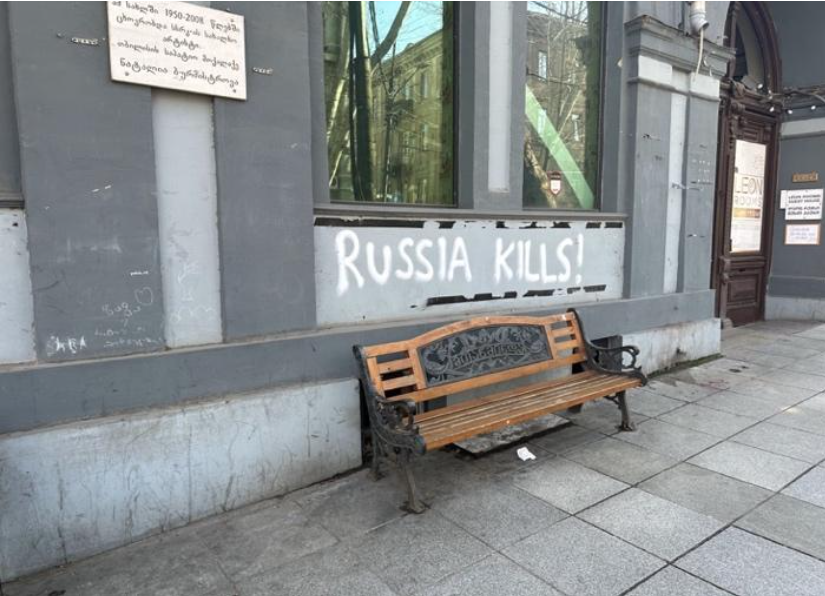
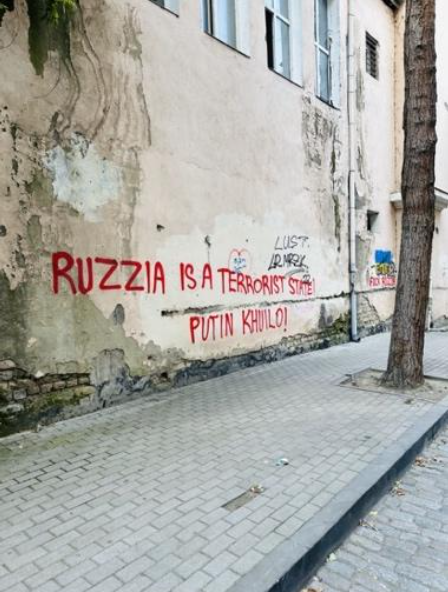
Walking through Tbilisi, he often passes graffiti accusing Russia of killing and calling it a terrorist state, as seen in the photos below taken by the author. When he sees those messages, he told me, he feels a sense of agreement. “It’s true,” he said. “Russia kills. It kills Ukrainians. It kills its own citizens too.”
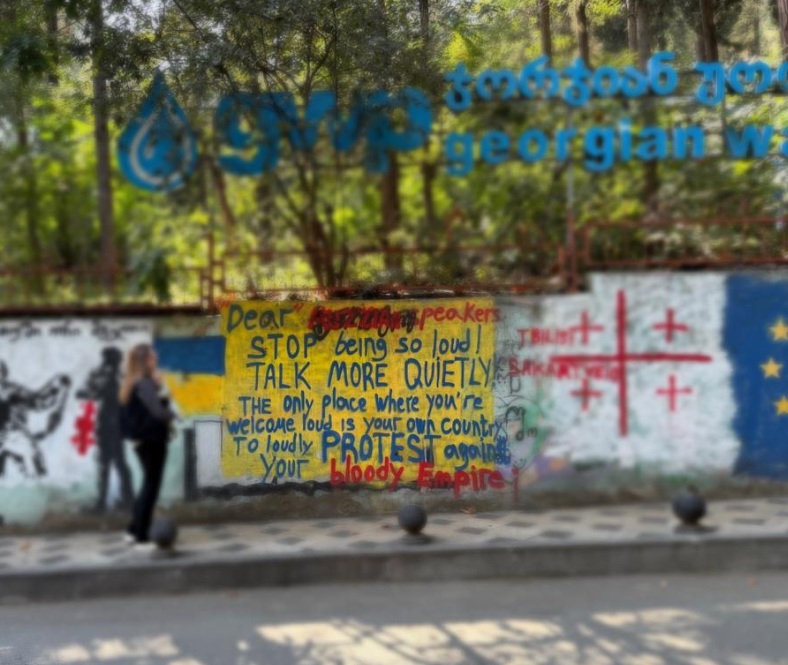
But the walls also carry another message. Near his apartment in Tbilisi, a large piece of graffiti greets him every day. Painted in the blue and yellow of the Ukrainian flag, it addresses “Ruzzian speakers”—a derogatory twist on "Russian" that incorporates the infamous “Z” symbol used by supporters of the invasion (Marandici, 2023)—and tells them to protest their empire back home (see photo below, taken by the author). For Roman, the wall captures the contradiction of his life in exile: the solidarity he feels with those condemning the war and the suspicion he must navigate as a Russian living in Georgia.
He insists that he is not a supporter of the war. But explaining why he did not resist from inside Russia, he said, is difficult for those who have never lived under a fully authoritarian regime. “It was like standing in front of a meteor,” he told me. “You see it coming, but there is nothing you can do to stop it.” In Georgia, he said, the meteor feels a little further away. Here, he has time to maneuver, to donate to Ukrainian causes, to help friends organize anti-war protests, and to speak openly against the invasion, things that, in Russia, could easily lead to prison.
Roman’s story is only one among many. In exile, people who once felt isolated begin to find one another. Many Russian migrants who opposed the war but could not safely organize at home now work together in new ways, through protests, volunteer initiatives, fundraising for humanitarian aid, and social media campaigns challenging the narratives promoted by the Russian state. I met Roman through the broader network of one such initiative, Emigration for Action (emigrationforaction.com), a project created by Russian emigrants in Georgia that supports Ukrainian refugees and connects Russian speakers who oppose the war. These efforts remain fragile, especially in a country shaped by its own colonial history with Russia. Yet exile has opened space for collective action. The men who refuse to fight are now finding one another and organizing together, turning individual refusal into small but growing forms of collective resistance.
References
Human Rights Watch. (2022, March 7). Russia criminalizes independent war reporting, anti-war protests. https://www.hrw.org/news/2022/03/07/russia-criminalizes-independent-war-reporting-anti-war-protests
Krawatzek, F., DeSisto, I., & Soroka, G. (2023). Russians in the South Caucasus: Political attitudes and the war in Ukraine (ZOiS Report No. 2/2023). Centre for East European and International Studies (ZOiS). https://www.zois-berlin.de/fileadmin/media/Dateien/3-Publikationen/ZOiS_Reports/2023/ZOiS_Report_2_2023.pdf
Marandici, I. (2023). Z-Propaganda and Semiotic Resistance: Contesting Russia’s War Symbols in Moldova and Beyond. Comparative Southeast European Studies, 71(4), 585-616. https://doi.org/10.1515/soeu-2023-0024