
Peace Leadership Begins with Listening
By Jack Nassar
Jack Nassar is a Palestinian Christian writer focusing on the Palestine-Israel conflict and its social, political and religious dimensions. He holds a Master of Arts degree in political communications from Goldsmiths University of London. He can be reached at: jacknassar@aol.com.
People ask me about peace often, and I still struggle to answer them well.
I am a Palestinian Christian living in the Holy Land. I have heard the word peace countless times, and it has almost lost its weight. Politicians say it. Diplomats say it. Churches say it and pray for it. Every conference has it on the program. But here, peace is something we hear about far more than something we live.
An American Evangelical Zionist once told me there will never be peace in Jerusalem until Jesus comes back. It is in the scriptures, she said. I was shocked. I know my scriptures well, and I have always believed peace in Jerusalem is possible, in our lifetime, not only at the end of days.
That gap between her certainty and my hope is what pushed me to think again about what peace leadership actually means.
I don't think it is mainly about agreements signed in hotel conference rooms. Those matter, but peace starts before that, in something much smaller. It starts when someone is willing to listen to a story that is not their own, especially when that story makes them uncomfortable.
Palestinian Christians know what it is to be left out of the story entirely. Ours is the oldest Christian community in the world. We did not arrive here. Our churches and our families have been in this land since Christianity started here. People know Bethlehem as the town where Jesus was born. Fewer know that Christians are still there, still worshipping, still burying their dead and baptizing their children, right now, today.
When a people's presence is treated as background information, it is hard to build peace around them. You cannot make peace with someone you have not first agreed exists.
“Maybe this is what peace leadership really is. Refusing to judge someone before you’ve heard their story. Admitting you may never fully understand someone else’s experience, even after years of trying. And still seeking justice without letting go of the other person’s humanity.”
My friend Camilia lives in Birzeit, a Christian-majority town next to Ramallah. During our Tai Chi session recently, she told me she had made about twenty kilograms of honey from her garden's bee cells. Her Muslim neighbor, Omar, keeps the hives with her. Her whole family celebrated the harvest as if it were a wedding. I asked her what made them all so joyful. She said, it gave us hope, Jack. Our family has harvested olive trees for generations, making our own oil every year, except since 2025, when we had to buy oil instead. It is our land, my grandfather bought it and planted the trees, we are the legal owners. We can no longer reach it. Israeli settlers stole it and threatened to kill us if we come near it.
I saw the sorrow in her eyes as she said it. It made me wonder what peace actually means to her. Is it justice? Is it being able to farm her olive trees again and press her own oil? Will peace ever bring that back? Will it come at all?
I have met people over the years who work for peace in ways that will never be reported. A teacher in Taybeh, the last all-Christian town, who keeps her classroom a place where children can ask hard questions about the near-daily Israeli settler attacks. A social worker in Hebron who sits with families who have buried someone and does not rush them toward forgiveness.
None of these people will be invited to a peace summit. But this is where peace is actually made. Not in the signing, but in the years of ordinary work before anyone is ready to sign anything.
I keep coming back to this from my own faith too. Jesus did not start with correction. He started by listening, and by staying present with people the rest of society had already written off, meeting the enemy, the marginalized, the sick, the persecuted, the sinner. Dignity came before agreement. That order matters, and I think we have it backwards.
A peace that asks people to forget what was done to them will not hold. I have seen this fail. But a grief that refuses to see the humanity of the other side will not hold either, not across generations. Holding both of these at once is the hard part. I don't have a clean formula for it. I only know that I have watched people manage it, and I have watched people fail at it, and the difference usually comes down to whether they were willing to sit in a room with someone from the other side and actually listen before they spoke.
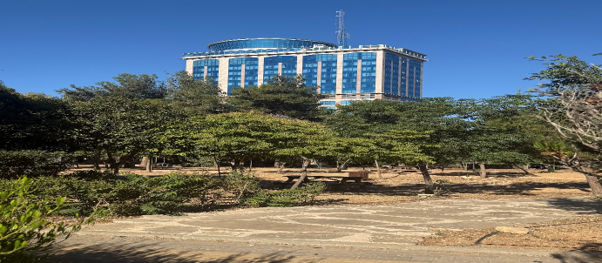
Al-Istiqlal (Independence) Park in Ramallah, with the Palestine Trade Tower visible in the background. Photo credit: Jack Nassar
This is part of why we are founding Mawadda Palestine Institute. Mawadda is an Arabic word, closer to warmth and affection than the English word "compassion" quite captures. A society under this much stress, division, violence, and fear needs actual rooms, not statements, where Palestinians from all different religions and ethnic backgrounds can meet across the lines that divide them. Education, dialogue, research, interfaith work, the slow work of culture. None of it waits for the politics to resolve first. It can't. The politics has been unresolved longer than I have been alive.
This pattern is not only Palestinian. People sort each other into labels, and a screen makes it easy to react to a label and never meet the person behind it.
Maybe this is what peace leadership really is. Refusing to judge someone before you've heard their story. Admitting you may never fully understand someone else's experience, even after years of trying. And still seeking justice without letting go of the other person's humanity.
I don't believe peace comes from pretending the differences aren't there. It comes from naming them honestly and choosing, again and again, to stay in relationship.
I think of Camilia's family again, and the twenty kilograms of honey they celebrated like a wedding, and the oil they can no longer press from their own trees. That is the choice in front of us here. Not a slogan. A choice, repeated, mostly in rooms no one else will ever hear about.